













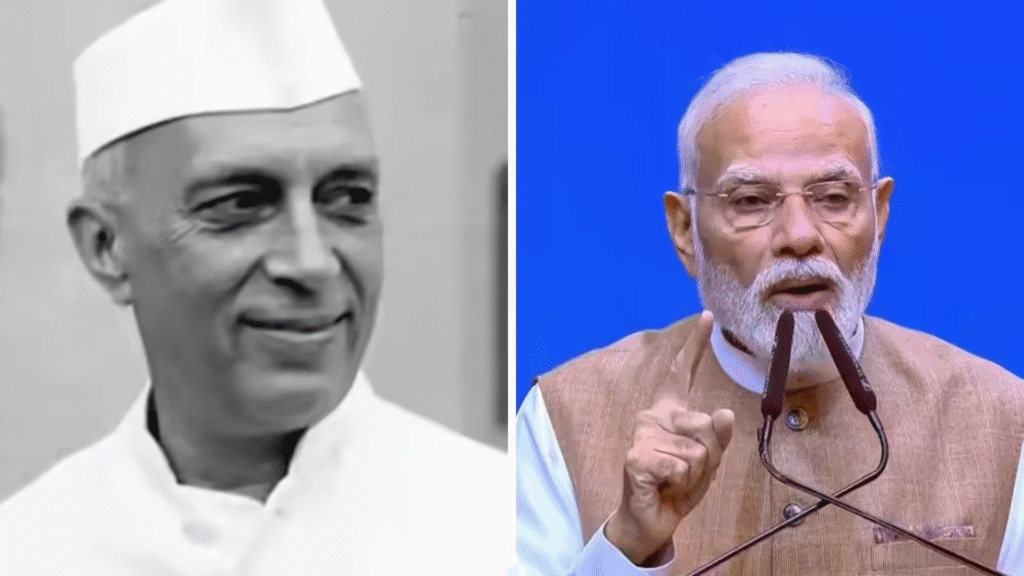
New Delhi: On the occasion of the nationwide commemoration of the 150th anniversary of Vande Mataram, the national song has become the center of a fresh political controversy. The Bharatiya Janata Party (BJP) has launched a significant historical charge, accusing India’s first Prime Minister, Jawaharlal Nehru, of committing a “historic sin” by deliberately truncating the song in 1937, specifically removing stanzas that hailed Goddess Maa Durga.
The Core Allegation: Truncating the National Song
The charge, led by BJP spokespersons and echoed by Prime Minister Narendra Modi, is focused on the decision taken by the Congress Working Committee (CWC) in 1937.
- The Claim: BJP asserts that the Congress, under the presidency of Nehru, adopted only the first two stanzas of Bankim Chandra Chatterjee’s original six-stanza composition, omitting the later verses that contained direct devotional references to Hindu deities like Durga, Lakshmi, and Saraswathi.
- The Motive Cited: According to the BJP, this action was driven by a “communal agenda” to appease certain sensitivities, primarily the concerns raised by sections of the Muslim League who viewed the song’s strong idol-worshipping imagery as exclusionary.
- Historical Evidence: BJP leaders have cited historical documents, including letters written by Nehru to Netaji Subhas Chandra Bose in 1937, where Nehru reportedly stated that the full song’s background was “likely to irritate Muslims” and opined that the song was “not suitable as a national song.”
Prime Minister Narendra Modi, while inaugurating the year-long commemoration, weighed in on the issue, stating that the decision to drop the important stanzas in 1937 “not only broke the song into pieces but also sowed the seeds of partition.”
The 1937 Context: The Congress Resolution
Vande Mataram, penned by Bankim Chandra Chatterjee in the 1870s and published in his novel Anandamath in 1882, became the rallying cry of the Indian freedom movement. It was first sung in an Indian National Congress session by Rabindranath Tagore in 1896.
The 1937 decision by the CWC followed protests from the Muslim League, especially in provinces where Congress formed governments, over the singing of the full song.
- The Resolution: The Congress officially adopted only the first two stanzas as the national song, arguing that these initial verses—which depict the motherland in geographical and non-deity-specific terms—were unobjectionable to any community. The later stanzas, which explicitly deified the nation as a manifestation of Goddess Durga, were the ones removed from the Congress’s official public recital.
- Role of Intellectuals: Historical accounts suggest the CWC resolution was influenced by advice sought from various quarters, including Rabindranath Tagore, who reportedly found the later stanzas, while harmless, potentially objectionable to those who believed in monotheism.
Congress Hits Back: ‘Proud Flagbearer’
The Congress party has swiftly rejected the BJP’s charges, labeling them a “distortion of history.”
Congress President Mallikarjun Kharge asserted that the party has always been the “proud flagbearer” of Vande Mataram, which “awakened the collective soul of the nation.” Congress leaders pointed out that the 1937 decision was an attempt to maintain unity across religious lines during the freedom struggle.
Senior Congress leader Jairam Ramesh cited historical accounts, noting that the decision was a crucial step taken to define the song’s place in public life and highlighted that the full song was one of the central symbols of the freedom movement that the Congress championed.
The political exchange ensures that as India celebrates 150 years of its powerful national song, the debate over its history, original form, and symbolism will remain intensely political.