













New Delhi | November 7, 2025
Today, November 7, 2025, marks a monumental milestone in India’s cultural and political history: the 150th anniversary of the composition of Vande Mataram, India’s cherished National Song.
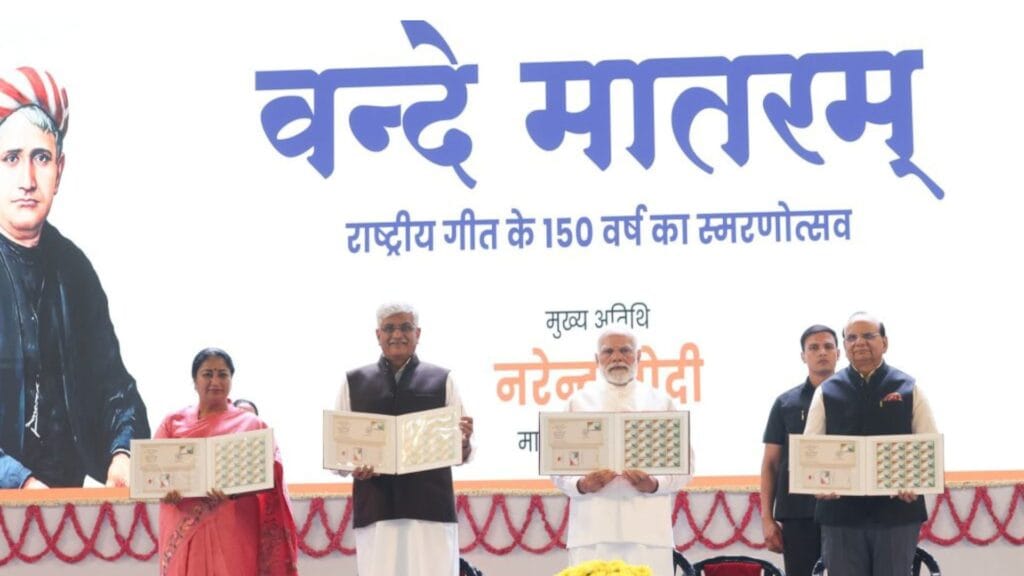
Across the nation, the anniversary is being celebrated with a year-long commemoration, launched today by the Prime Minister. The ceremonies, which included the release of a commemorative stamp and coin, highlighted the song’s enduring power as “a mantra, an energy, a dream, and a resolve.” The collective rendition of the anthem today reaffirms its timeless role as the heartbeat of Indian patriotism.
But to truly appreciate the song’s legacy, one must journey back to its revolutionary origins.
The Genesis: A Hymn of the Motherland (1875)
Vande Mataram—meaning “Mother, I bow to thee”—was composed by the literary giant and poet-novelist Bankim Chandra Chatterjee in 1875.
Written in Sanskrit, the hymn was revolutionary in its vision: it personified the Motherland (Maa Bharati) not just as a geographical entity, but as a divine goddess, a figure of strength, prosperity, and devotion.
It was first published in Chatterjee’s Bengali literary journal Bangadarshan and later gained immortality when he incorporated it into his 1882 novel, Anandamath. Set against the backdrop of the Sannyasi Rebellion, the song became the sacred oath of the ascetics fighting for the nation, cementing the powerful concept of the “religion of patriotism.”
From Song to Slogan: The Battle Cry of Independence
While Bankim Chandra Chatterjee planted the seed, it was the nationalist movement that turned it into a forest fire.
In 1896, Gurudev Rabindranath Tagore first sang Vande Mataram in a political session—the annual convention of the Indian National Congress in Calcutta. This public performance immediately elevated the hymn’s status.
Its moment of true political transformation came in 1905 during the fiery Swadeshi and Anti-Partition movements in Bengal. As thousands gathered in Calcutta to protest Lord Curzon’s controversial partition plan, the two simple words—Vande Mataram!—became the unifying political slogan, instantly recognizable across linguistic and regional boundaries.
The British colonial administration, recognizing its unparalleled ability to rally the masses, resorted to banning its public recital and arresting those who chanted it. However, the ban only intensified its significance, turning the song into an anthem of defiance. It was the rallying cry of revolutionaries, whispered by patriots on their way to the gallows, and even inscribed on the first version of the Indian flag unfurled by Madam Bhikaji Cama in Stuttgart, Germany, in 1907.
A Legacy of Equal Honour
The song’s profound contribution to the freedom struggle was formally acknowledged decades later.
On January 24, 1950, the Constituent Assembly of India, while adopting Jana Gana Mana as the National Anthem, gave Vande Mataram an equally revered status. Dr. Rajendra Prasad, the then-President of the Assembly, declared that the song “shall be honoured equally” with the National Anthem.
As India enters the 150th year of this majestic composition, we are reminded that Vande Mataram is more than just a song. It is the poetic articulation of India’s collective consciousness, a sacred link to the sacrifices of the past, and a powerful, enduring reminder of our national unity.