

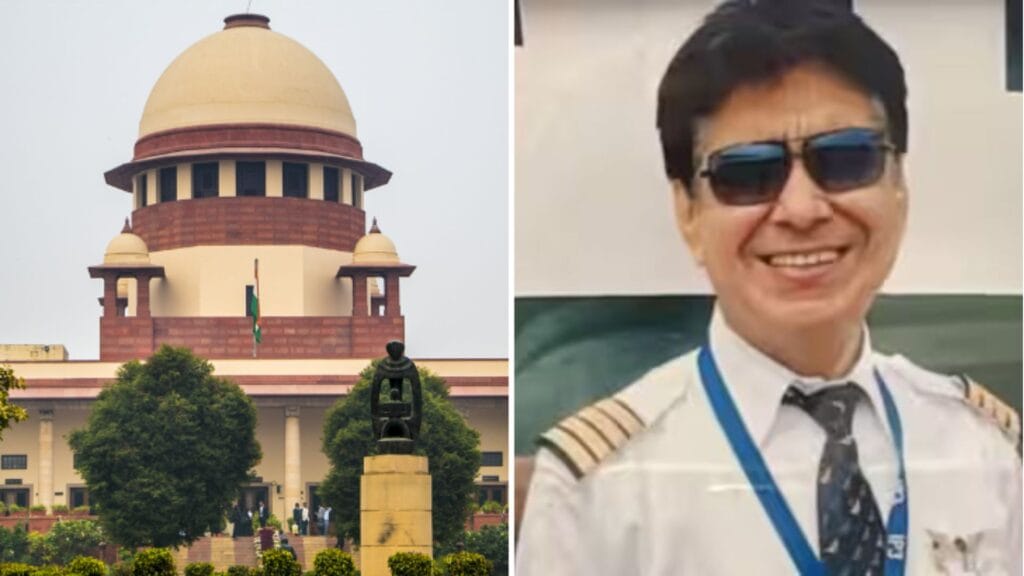
New Delhi, – In a rare and emotional moment of judicial empathy, the Supreme Court of India today reassured the 91-year-old father of the pilot-in-command of the ill-fated Air India Boeing 787 Dreamliner, Captain Sumeet Sabharwal, that his son was not to blame for the tragic crash in Ahmedabad.
Hearing a petition that demanded a fair and judicially monitored inquiry into the accident, the court addressed the grief-stricken father directly, telling him: “Don’t carry this burden on yourself. The pilot is not to be blamed for the plane crash. It was an accident.”
A Court’s Reassurance and Condemnation of Media Reports
The crash of Air India Flight AI-171 in June, which claimed over 260 lives, has been under intense scrutiny. Amid swirling speculation and preliminary reports, senior counsel for the petitioner, Pushkar Raj Sabharwal, raised concerns over foreign media articles, specifically citing a report in the Wall Street Journal that allegedly hinted at pilot error.
The bench, comprising Justices Surya Kant and Joymalya Bagchi, firmly rejected this narrative.
- Justice Surya Kant stated, “No one in India believes it was the pilot’s fault.”
- Responding to the foreign media report, Justice Kant remarked, “It was nasty reporting only to blame India.”
The court further clarified that the preliminary report by the Aircraft Accident Investigation Bureau (AAIB) contained “no insinuation” against Captain Sabharwal. The report only mentioned the cockpit voice recorder dialogue where one pilot was heard asking the other if they had moved a fuel cut-off switch, with the other pilot denying it.
The Call for a Judicially Monitored Probe
The core of the petition filed by Captain Sabharwal’s father and the Federation of Indian Pilots (FIP) is the demand for a “fair, transparent, and technically robust” investigation, overseen by a retired Supreme Court judge.
The petitioners argued that:
- The ongoing probe by the AAIB is not independent and has been compromised.
- The sole objective of an aircraft accident investigation, per international norms (ICAO Annex 13), should be prevention of future accidents, not the premature apportionment of blame.
Acknowledging the gravity of the matter and the constitutional right to life (Article 21) which includes aviation safety, the Supreme Court issued a formal notice to the Centre, the Directorate General of Civil Aviation (DGCA), and the AAIB, seeking their detailed responses.
The court made it clear that if necessary, it would issue a clarification stating on record that the pilot cannot be blamed for the tragedy. The case is scheduled for further hearing next week, alongside other pending petitions related to the crash.
Key Takeaways from the SC Hearing:
| Aspect | Court’s Observation/Action |
| Pilot’s Role | “The pilot is not to be blamed for the plane crash… Nobody can blame him for anything.” |
| Relief to Family | Advised the 91-year-old father, “Don’t carry this burden on yourself.” |
| Investigation Status | Issued Notice to the Centre, DGCA, and AAIB on the plea for a judicially monitored, independent probe. |
| Media Criticism | Dismissed a foreign media report suggesting pilot error as “nasty reporting only to blame India.” |