










New Delhi | November 5, 2025
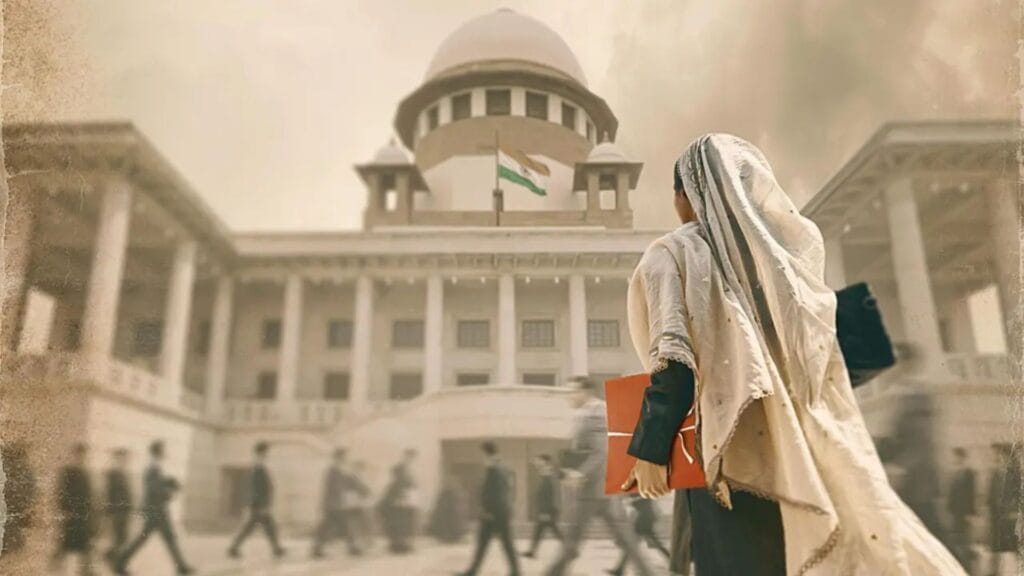
The upcoming release of the film ‘Haq’, starring Yami Gautam Dhar and Emraan Hashmi, is doing more than just filling cinema seats—it’s reopening one of the most consequential chapters in India’s legal and political history: the landmark Shah Bano Begum case of 1985.
Scheduled for release on November 7, the courtroom drama is inspired by the battle of Shah Bano, an Indore woman whose pursuit of dignity and financial security after divorce exposed the deep fault lines between secular law, religious personal laws, and women’s rights in the country. The controversy is already building, with Shah Bano’s own daughter reportedly moving the High Court to seek a stay on the film’s release, alleging unauthorized and misrepresented depiction of her mother’s life.
The Fight for Maintenance: Why Shah Bano Went to Court
The story begins in 1978, when 62-year-old Shah Bano Begum, a mother of five, was divorced by her husband, Mohammed Ahmed Khan, a prominent lawyer, after 43 years of marriage. After her husband stopped providing the promised maintenance, she took a courageous step and filed a petition in the local court.
Her legal fight was not filed under Muslim Personal Law, but under Section 125 of the Criminal Procedure Code (CrPC). This is a secular, welfare provision that applies to all citizens, regardless of religion, and mandates that a person of sufficient means must provide maintenance to dependents, including a divorced wife who is unable to maintain herself.
Her husband contested the plea, arguing that under Muslim Personal Law, his financial obligation was limited to the iddat period—the mandatory waiting period of roughly three months following the divorce—and the payment of Mehr (dower).
The Landmark Verdict That Shook the Nation
On April 23, 1985, the Supreme Court of India delivered a unanimous verdict that would reshape the national conversation on gender justice.
The five-judge Constitution Bench ruled decisively in Shah Bano’s favor, holding that:
- Section 125 of CrPC is secular and applies to all citizens to prevent destitution and vagrancy.
- A divorced Muslim woman is entitled to maintenance from her former husband beyond the iddat period if she cannot maintain herself.
- The judgment asserted that secular law takes precedence over personal law in matters of maintenance to ensure basic human rights.
The court even took the opportunity to express regret that Article 44 of the Constitution, which calls for a Uniform Civil Code (UCC)—a common set of laws governing personal matters for all citizens—remained a “dead letter.”
The Political Overturn: The Act of 1986
The progressive judgment was immediately met with fierce backlash from conservative Muslim groups and clerics, who viewed it as an encroachment on Sharia law and an attack on their religious identity. Massive protests and political polarization ensued.
Under immense pressure, the then-Rajiv Gandhi-led government enacted the Muslim Women (Protection of Rights on Divorce) Act, 1986. This Act effectively nullified the Supreme Court’s verdict, severely restricting the rights of divorced Muslim women by limiting the husband’s liability for maintenance to only the duration of the iddat period. After that, the woman was to rely on relatives or the state-run Waqf Board.
A Legacy That Endures Today
Despite the political reversal, the spirit of the Shah Bano judgment was later upheld by the Supreme Court through creative interpretation. In the Danial Latifi v. Union of India case, the court ruled that the “reasonable and fair provision and maintenance” mandated by the 1986 Act must be a one-time lump-sum payment made during the iddat period, sufficient to maintain the divorced woman for the rest of her life. This restored much of the financial protection initially granted to Muslim women.
The case remains a watershed moment, not just for maintenance law, but for setting the stage for subsequent judicial reforms. It laid the groundwork for the eventual striking down of Triple Talaq (instantaneous divorce) by the Supreme Court in 2017, demonstrating the judiciary’s ongoing role in safeguarding gender equality against the rigidities of personal laws.
As ‘Haq’ reaches the silver screen, it serves as a powerful reminder of the arduous fight for a uniform code of justice, where a woman’s fundamental rights stand above religious and political expediency.